How Can You Tell If a Robocall Is AI-Generated? Here's What to Look and Listen For.
If you’ve received a robocall that sounded surprisingly real — a voice that seemed to belong to a candidate, a local official, or even someone you know — you are not imagining things. AI voice cloning technology has improved to the point where synthetic voices can be difficult to distinguish from genuine ones, even for careful listeners.
So how do you tell the difference? Here’s what to listen for, and what to do when something feels off.
The Direct Answer
You often cannot tell with certainty by listening alone. That is the honest starting point. AI-generated voices have become capable enough that no single acoustic tell reliably exposes them. What you can do is pay attention to the circumstances of the call, not just the sound of the voice.
Warning Signs to Listen and Watch For
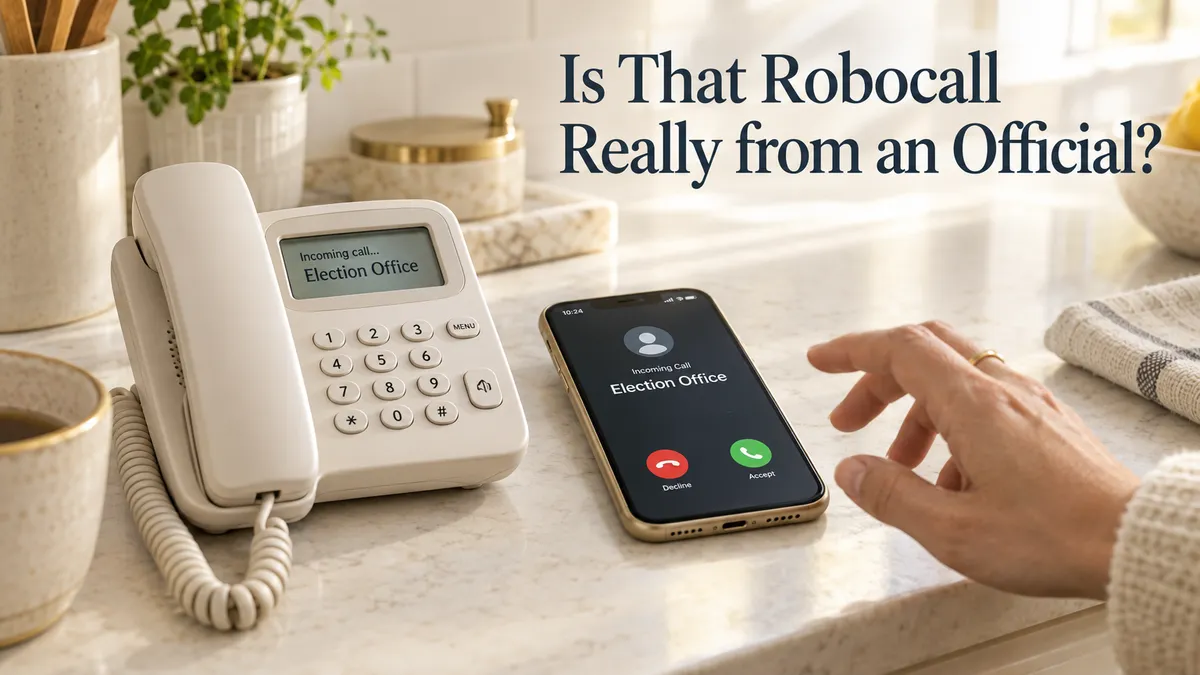
Unexpected urgency or pressure. Legitimate election officials and candidates do not typically call unsolicited and pressure you for an immediate response, personal information, or action. Urgency is a manipulation tactic — real or AI-generated.
A request for personal information. No legitimate voter registration process is conducted through an unsolicited phone call asking you to confirm your name, address, date of birth or identification details. If a call asks for this information, treat it as suspicious regardless of how official the voice sounds.
A number you cannot verify. AI-driven robocall operations often use spoofed or unrecognisable numbers. If you call back the number that contacted you and reach something unexpected, that is a signal.
Claims that feel off. Synthetic content is sometimes built around plausible-sounding but false premises — “your registration has lapsed,” “polling location has changed,” “you must confirm your details to vote.” Cross-check any civic claim through an official source before acting on it.
A voice that sounds slightly flat or overly smooth. This is not a reliable indicator — high-quality AI voices do not all share this characteristic — but if a voice sounds strangely uniform in tone or cadence, it is worth pausing.
What to Do When You’re Unsure
- Don’t provide personal information during the call. Hang up first, then investigate.
- Find the official source independently. Go directly to your state or local election authority website — type the address yourself rather than following a link provided in the call or a subsequent text message.
- Call back on a number you find yourself. If you want to verify whether a call was legitimate, find the contact number for the relevant office through official channels and call it directly.
- Tell someone. If you received a call you believe was a scam, report it to the FTC at ReportFraud.ftc.gov and your local election authority. Sharing the experience with family members helps them recognise it if they receive something similar.
Why This Matters Beyond Election Season
The same voice cloning technology used in AI-generated political robocalls is used in other scam contexts: a call that sounds like a grandchild in an emergency, a message that seems to be from your bank, an instruction that appears to come from your employer. The habit of independent verification — checking before acting — applies in all of these situations.
The FBI’s October 2026 alert specifically noted that some operations posing as voter services are designed to harvest personal data. The goal in those cases is not political — it is data collection that can be exploited in other ways.
The Underlying Principle
Recognition is not verification. Hearing a familiar or authoritative voice does not confirm the caller is who they claim to be. Building the habit of independent verification — before providing personal information or taking consequential action — is the practical response to a world in which synthetic voice has become convincingly realistic.
Know what changed. Know what matters. Know what to do.
AI Failsafe helps families understand AI-powered scams, digital risks and practical steps to stay safer.
Build safer habits in just five minutes a day with the 30-Day Family AI Safety Challenge.
Source: https://emergent.sh/news/fbi-warns-rising-ai-powered-election-scams